
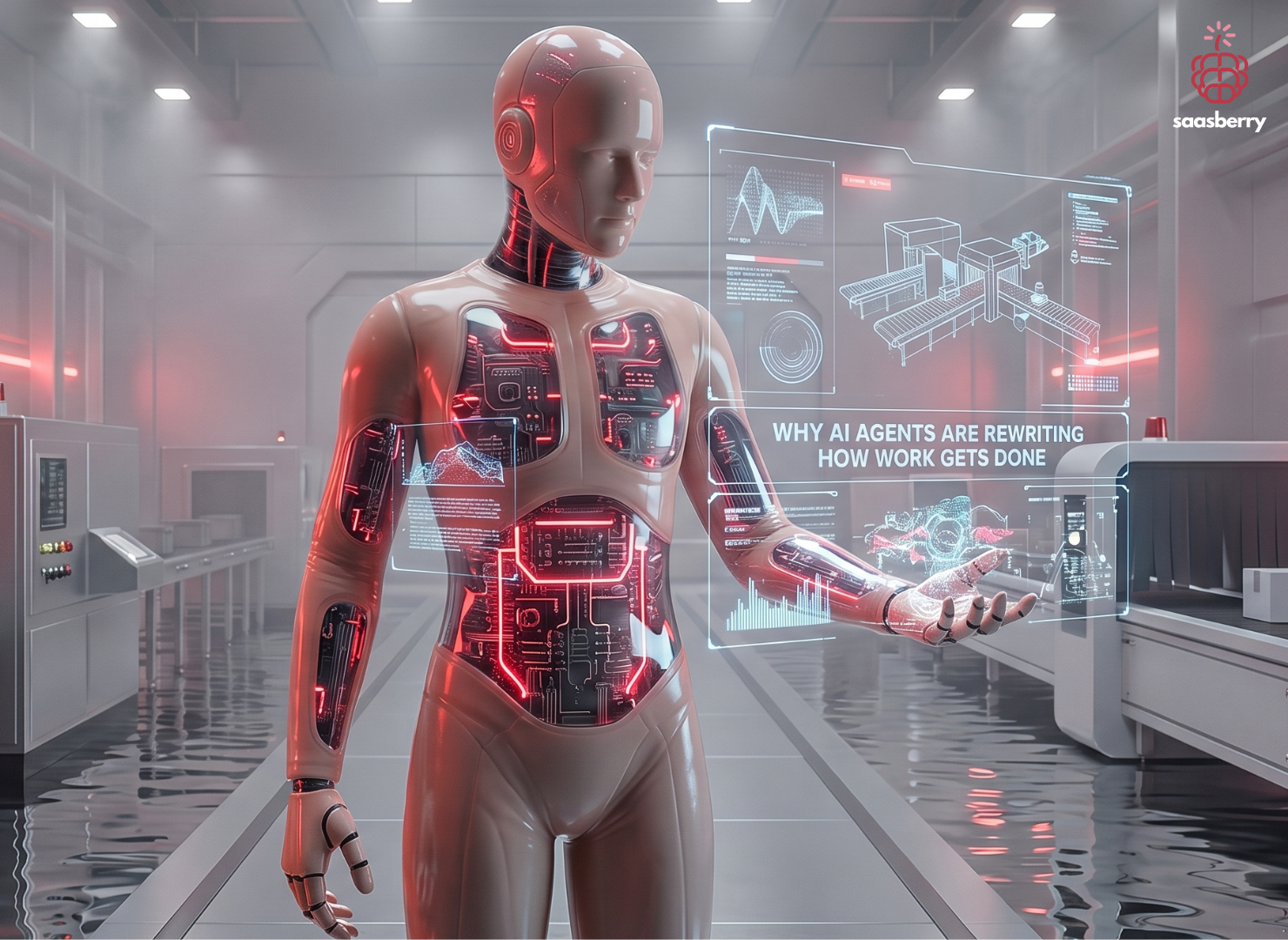
Why AI Agents Are Rewriting How Work Gets Done
Something fundamental just broke in enterprise technology.
Not an update.
Not a new tool.
Not another “AI feature.”
The entire concept of software is being replaced.
1. The Shift No One Is Talking About
For the last 20 years, enterprise software worked like this:
- Humans clicked buttons
- Software responded
- Work got done manually
Even with automation, the model stayed the same:
humans orchestrate → software executes
That model is collapsing.
In its place, a new one is emerging:
AI doesn’t assist work anymore. It performs it.
Not step-by-step.
Not with instructions every time.
But end-to-end execution of tasks, workflows, and decisions.
This is the rise of autonomous agents.
From Tools → Operators
The biggest innovation isn’t smarter models.
It’s this:
AI systems that can plan, decide, and
act across entire workflows
without constant human input.
These systems can:
- break down complex objectives
- call tools and APIs
- coordinate multiple steps
- correct themselves mid-task
- deliver outcomes, not suggestions
This is no longer:
- generate a response
- suggest a draft
This is:
- run the process
- complete the task
- deliver the result
And once that shift happens… software becomes invisible.
2. The Rise of “Autonomous Work”
We’re entering a world where:
- Marketing campaigns launch themselves
- Financial reports assemble automatically
- Customer conversations convert without reps
- Operations adjust in real-time
What used to require:
- teams
- meetings
- coordination
can now be handled by systems that operate continuously in the background
This is why agent-based systems are being deployed across:
- operations
- customer support
- development
- finance
- healthcare workflows
Not as experiments.
But as core infrastructure.
Why This Is Bigger Than SaaS
It just digitized it.
You still needed:
- dashboards
- logins
- workflows
- headcount
AI agents don’t just digitize work.
They absorb it.
Instead of:
- using CRM → the agent manages pipeline
- using analytics → the agent generates insight + action
- using automation → the agent decides what to automate
This is a category shift, not a feature upgrade.
3. The Real Breakthrough: Context + Action
- context (how your business actually works)
- memory (what’s already happened)
- authority (permission to act)
Now systems are being designed with:
- deep integration into company data
- awareness of workflows and roles
- structured governance and permissions
So they don’t just answer questions.
They operate inside the business itself.
That’s the unlock.
4. The New Enterprise Stack
- Intelligence layer → reasoning + decision-making
- Context layer → company data + workflow understanding
- Action layer → tools, APIs, execution
- Governance layer → permissions, monitoring, control
Everything is being rebuilt around one idea:
How do we let AI act safely inside real business operations?
Not assist.
Not recommend.
Act.
The Reality
The biggest innovation in enterprise AI today is simple:
Work itself is becoming software.
And software?
It’s becoming invisible.
If SaaS was about digitizing work,
this era is about eliminating the need to do it at all.
If you want to explore how AI agents could transform your operations, we’d love to connect.