
Protests Say “Pause AI.” Here’s Why the Real Answer Is Learning to Steer.
The fear is real. The protests are growing. But stopping AI isn’t an option, deploying it responsibly is.
1. The March Nobody Can Ignore
On March 21, 2026, nearly 200 protesters marched through San Francisco's tech district — from Anthropic's headquarters to OpenAI's to xAI's — under a single banner: Stop the AI Race.
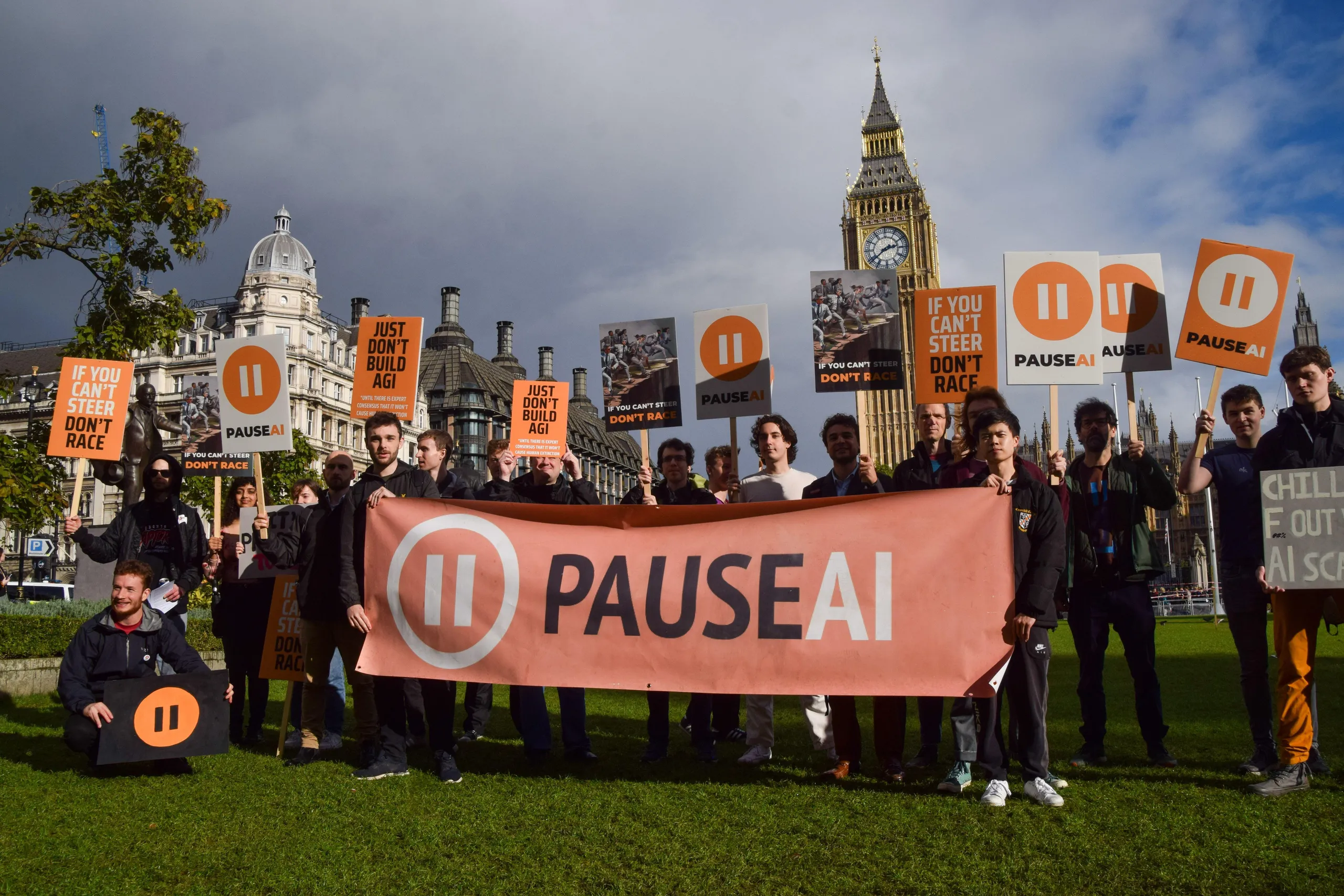
Weeks earlier, hundreds more rallied through London’s King’s Cross, home to the UK offices of OpenAI, Meta, and Google DeepMind. Signs read “Pause before there’s cause” and “EXTINCTION=BAD.” Chants of “Pull the plug!” echoed between glass towers. The movement, organized by groups like PauseAI and Pull the Plug, was billed as the largest anti-AI demonstration in history.
By April, PauseAI US was on Capitol Hill for a Day of Action, meeting with members of Congress. Their online petition has surpassed 110,000 signatures — including AI researchers, political leaders, and industry figures. Pope Leo XIV, in his first encyclical in May 2026, called for preventing AI from “dominating humanity.”
This isn’t fringe anymore. This is a global movement with real momentum, real fear, and real people behind the signs.
2. They're Not Wrong to Be Scared
Here's the hard truth nobody in tech wants to say out loud: the protesters have a point.
AI systems are being deployed at a pace that outstrips the safety infrastructure meant to govern them. A Fortune 500 financial services company recently discovered its AI models were making lending decisions with 23% bias against minority applicants — and its governance framework, built just a few years earlier, couldn’t even detect the problem. Harvard Business Review reports that 79% of senior IT leaders have concerns about AI security risks, and 73% worry about biased outcomes.
The fear is not irrational. The companies building frontier AI have acknowledged the risks themselves. Geoffrey Hinton — Nobel Prize winner and “Godfather of AI” — has warned repeatedly about job displacement, misuse by bad actors, and systems that surpass human control. Even the CEOs racing to build these systems have publicly stated that the risk of extinction is real.
So when people take to the streets with signs that say “If you can’t steer, don’t race” — they’re asking the right question.
3. But Stopping Isn't an Option
Here's where the conversation splits.
AI isn’t a feature you can roll back. It’s infrastructure now. It’s embedded in healthcare diagnostics, logistics routing, financial underwriting, defense systems, hiring platforms, and supply chain management. It’s not a toggle. It’s the wiring.
The companies building it aren’t slowing down. The governments funding it aren’t pulling back. And the competitors in your industry who already deployed it? They’re not waiting for permission.
McKinsey’s 2026 AI Trust Maturity Survey — conducted across approximately 500 organizations — confirms the trajectory: enterprises are moving beyond experimentation toward scaled deployment of generative AI and, increasingly, agentic AI across core business functions. The question has shifted from “Should we use AI?” to “How fast can we deploy it, and what’s the ROI?”
Meanwhile, the White House has released a new AI legislative framework aimed at nationalizing AI policy. The EU AI Act is in effect, with penalties up to 7% of global revenue for non-compliance. US federal agencies now require AI impact assessments for government contractors. States like California and New York have enacted AI transparency laws.
The train has left the station. The only question is who’s driving.
4. The Real Conversation Nobody's Having
The protest signs frame it as a binary: pause or perish. But the actual conversation that matters is happening in boardrooms, not on sidewalks — and it's far more nuanced.
The real question isn't "Should we use AI?" It's:
- How do we deploy it with governance?
- How do we ensure transparency in how models make decisions?
- How do we measure ROI so we know it's actually working?
- How do we keep humans in the loop where it matters?
- How do we build accountability into the system — not as an afterthought, but as architecture?
The World Economic Forum put it plainly in January 2026: "Governance provides the traction for acceleration while keeping your business on the road. Without good governance, AI initiatives tend to fragment — stuck in data silos, incomplete processes, undefined roles, and duplication of effort." In other words, governance isn't the brake. It's the steering wheel.
What "Learning to Steer" Actually Looks Like
So what does responsible AI deployment look like in practice? It's not a manifesto. It's operational.
Governance-first deployment: AI agents are embedded into specific workflows with clear accountability structures, defined escalation paths, and human oversight at critical decision points.
Transparency by design: Organizations can explain what their AI does, why it made a decision, and how it can be audited. No black boxes.
Measurable ROI: Every deployment is tied to a business outcome — processing time reduction, error rate improvement, cost savings. If you can't measure it, you can't justify it.
Humans in the loop: AI handles the repetitive, high-volume work. Humans handle judgment, context, and exceptions. The system is designed so neither operates alone.
Continuous monitoring: Static governance reviews are dead. Real-time monitoring of model performance, bias detection, and security threats is the new standard.This is the difference between racing blindly and racing with intent. The signs say "If you can't steer, don't race." Fair enough.Type your paragraph here
The Danger Was Never AI Itself
The danger was always handing powerful technology to organizations that move fast and skip accountability.
We've seen this movie before. Social media platforms were given sweeping legal protections under Section 230 — and for years, there was no accountability for the platforms. As tech expert Ahmed Banafa of San Jose State University noted: "Now we're dealing with the consequences because we were excited about how it was going to connect people, but there was no accountability for the platforms."
AI is at the same inflection point. The companies that deploy it without governance, without transparency, without measurable outcomes — they're the risk. Not the technology.
IBM's 2026 AI Governance Implementation Guide reinforces this: organizations that can't explain AI outcomes face reputational harm, audits, litigation, and fines. The ones that embed governance early avoid fragmentation, reduce risk, and actually scale faster.
connect.